The Noise Is Real. So Is the Confusion.
If you've been to a trade show in the last two years, you've heard the word "AI" attached to half the booths. Estimating software. Customer communication tools. Parts sourcing platforms. Shop management systems. All of them have added "AI-powered" to their marketing materials.
Some of this is genuine. Some of it is a rebrand of features that have existed for years. And most of the marketing is written for investors and tech enthusiasts, not for shop owners who need to run fifteen cars through on a Tuesday.
So let's start from the beginning. What is AI, in plain terms, and what does it actually do in a collision repair context?
What AI Actually Means (In Plain Terms)
You don't need to understand how AI works to use it effectively. But you do need to understand what it is so you can tell the difference between real capability and a sales pitch.
Think of it this way: AI is software that has been trained on a large amount of examples to recognize patterns and make predictions. That's it. It's not magic. It's not thinking. It's pattern recognition at scale, done very fast.
In practice, AI in collision repair is usually one of three things:
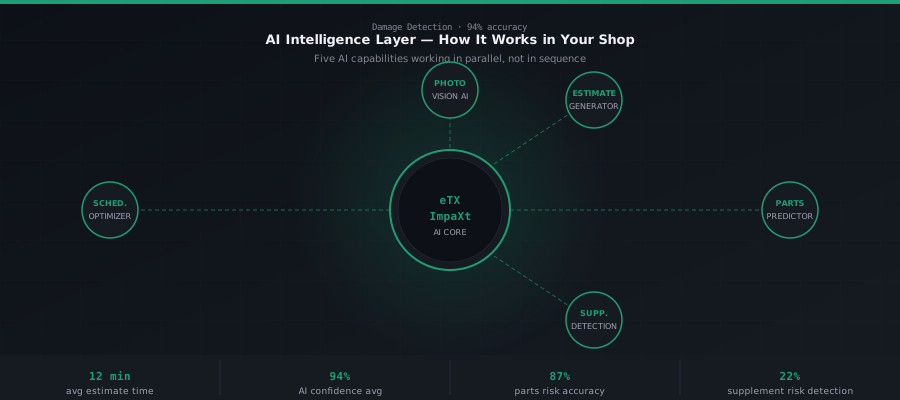
- Computer vision. Software trained to look at photos and identify what's in them. You show it a picture of a vehicle and it can tell you: there's a dent in the rear quarter panel, the bumper fascia is cracked, that weld has separated. It's doing what a trained eye does - but it can do it on a hundred photos in seconds instead of minutes.
- Pattern matching. Software that has seen millions of estimates and learned what damage patterns typically require which repair procedures. When it sees that kind of damage, it suggests those procedures. It's drawing on collective history, not general intelligence.
- Workflow automation. Once the system identifies damage and suggests procedures, automation handles the downstream steps - populating estimate fields, triggering tasks, sending notifications, generating documentation. This is where real time savings happen in day-to-day operations.
When a vendor says "AI-powered estimating," they mean some combination of these three things. Your job is to understand which ones, how well they work, and whether they fit your workflow.
Where AI Genuinely Helps in Collision Repair
Let's be specific about the areas where AI adds real, demonstrable value - not theoretical value, but the kind of value you can measure in time or dollars.
Photo-Based Damage Review
This is the strongest current application of AI in collision repair. A well-trained computer vision system can review a set of damage photos and flag what it sees - dented panels, cracked plastic, damaged structure - faster than a person. It doesn't get tired at estimate number eight. It doesn't miss things because it's also fielding a call from an adjuster.
This doesn't eliminate the estimator. The human still has to make the final judgment. But it gives the estimator a starting point that's more complete than a blank screen, and it catches things that get missed in manual review. That's real value.
Procedure Flagging
When damage is identified, AI trained on historical estimate data can suggest the repair procedures that typically apply. If the system has seen thousands of similar damage patterns, it knows that this kind of impact on this part of this vehicle type usually requires these procedures. That's a faster starting point than writing from scratch - and it reduces the risk of missing a procedure that should have been included.
Documentation and Communication
AI can draft customer updates, supplement notes, and procedure documentation from structured inputs much faster than a person typing from scratch. This is one of the most undervalued time savings in day-to-day shop operations. The drafts still need a human review - but generating the first version in seconds instead of minutes adds up across dozens of communications per week.
Supplement Pattern Detection
Systems trained on large volumes of claim data can flag when an initial estimate is likely to result in a supplement, based on damage type, vehicle make, and other variables. Knowing this early - before the car goes into production - changes how you handle scheduling, customer communication, and parts ordering. It's not a guarantee, but it's better information than a guess.
Where AI Still Falls Short
This is the part most vendors skip. Be skeptical of any AI pitch that doesn't talk honestly about limitations.
AI does well
- High-volume photo review on common vehicle types
- Standard procedure flagging on familiar damage patterns
- Generating first-draft documentation
- Identifying what's visible in photos quickly
- Automating downstream workflow steps
AI still struggles
- Unusual damage patterns it wasn't trained on
- Rare vehicles or low-volume makes
- Negotiating supplement disputes with adjusters
- ADAS calibration and precision structural work
- Reading a customer's frustration and responding appropriately
Judgment calls are still human calls. When an adjuster says something doesn't pay and you know it should, that's a conversation that requires experience, relationships, and documentation. AI can help you prepare. It can't do the negotiating.
Edge cases are where AI fails. AI models are only as good as the data they were trained on. A vehicle make with limited training data, a damage pattern that's uncommon, or a structural situation that's outside the model's experience - these are where the system underperforms and your estimator's expertise matters most.
The physical work remains entirely human. AI can flag that a scan is required. It can't calibrate a lane-departure system. It can note that structural repair is needed. It can't align the frame. The skilled work in the shop belongs to the people in the shop.
AI amplifies what's already working. A shop with clear processes, consistent documentation habits, and disciplined estimating will get more out of AI tools than a disorganized shop. AI is not a fix for a broken operation. It's a force multiplier for a functioning one.
Questions to Ask Any AI Vendor
Before you sign anything, get specific answers to these questions. Vague responses are not acceptable.
Due diligence checklist
- What does it actually do? Ask them to demonstrate the specific feature with real collision data, not a curated demo. If they can't show you the system working on typical damage photos from the kinds of vehicles you repair, the demo doesn't tell you much.
- What was it trained on? AI is only as good as the data it learned from. Was it trained on actual collision repair estimates and damage photographs, or on generic image data? How many vehicles? From which regions and repair environments?
- What does integration look like? Does it connect to your existing estimating system - CCC, Mitchell, Audatex - or does it operate as a standalone tool? If it's standalone, how does the output get into your workflow? Every manual handoff is a place where the benefit shrinks.
- What happens when it's wrong? Every AI system makes mistakes. Ask what the error rate is. Ask how errors are flagged and corrected. Ask who is responsible for catching them. If the answer is "you are," you need to factor that into your evaluation.
- Can you show me results from shops like mine? A single-location shop running 15 estimates a week in Texas is a different environment than a 10-location MSO. Ask for case studies from comparable operations. Ask for actual numbers - time savings, supplement rates, approval rates - not testimonial quotes.
The Right Tool Solves the Right Problem
The question isn't "should my shop use AI?" The question is: what specific problem am I trying to solve, and does this tool actually solve it?
If photo review is consuming too much of your estimator's time, there are AI tools that address that directly. If your supplement documentation process is inconsistent, AI can help build documentation faster. If you're struggling to communicate proactively with customers about repair status, AI-assisted communication tools can close that gap.
Each of these is a specific problem with a specific solution. What doesn't work is buying a platform because it has "AI" on the label and hoping it fixes things that aren't well-defined.
The shops that benefit most from this technology are the ones who approach it the same way they approach any other equipment purchase: with a clear problem to solve, a standard to measure against, and a willingness to evaluate honestly once the system is running.
That's not a high bar. It's just the same bar you'd set for anything else you bring into your shop.